
7 Fun Rainy Day Activities for Kids in Brooklyn That Make Learning Exciting
Rainy days don’t have to mean spending hours in front of a screen or hearing, “I’m bored!” from across the house.
Rain, snow, sleet, and other forms of precipitation can create exciting opportunities for children to explore science, ask questions, conduct experiments, and discover more about the world around them.
For families searching for rainy day activities for kids in Brooklyn, weather can become a hands-on science laboratory right outside your door.
Whether you live in Park Slope, Cobble Hill, Carroll Gardens, Boerum Hill, Gowanus, or another nearby Brooklyn neighborhood, these fun weather activities can help your child stay active, creative, and curious while developing important STEM skills.
Families looking for even more hands-on STEM activities for kids in Brooklyn can explore the exciting science programs, classes, camps, and educational experiences available at Brooklyn Science Spot.
Turn Rainy Days Into STEM Learning Adventures
Children are naturally curious about weather.
Why does it rain? Where do puddles go? Why are snowflakes shaped differently? How do meteorologists know when a storm is coming?
Questions like these create opportunities for parents to introduce children to science, technology, engineering, and math through everyday experiences.
Rain, snow, sleet, and hail are all forms of precipitation that children can observe and investigate. Families who want to explore weather science further can visit the National Weather Service JetStream Weather Education Program to learn more about clouds, precipitation, storms, and other weather phenomena.
The next time the skies turn gray, try one of these fun STEM activities with your child.
1. Create Colorful Rain Art
Turn a rainy Brooklyn afternoon into an outdoor art and science experiment.
Give your child washable sidewalk chalk, watercolor paints, or washable tempera paint and let them create artwork on a sidewalk, driveway, or another safe outdoor surface during a light drizzle.
Then watch what happens.
How does the water change the colors?
Do the colors mix together?
Does the rain make the artwork spread across the pavement?
Encourage your child to make predictions before the rain begins to interact with the artwork.
This simple activity combines creativity with scientific observation and helps children explore how water interacts with different materials.
You can even photograph the artwork before, during, and after the rain to compare how it changes over time.
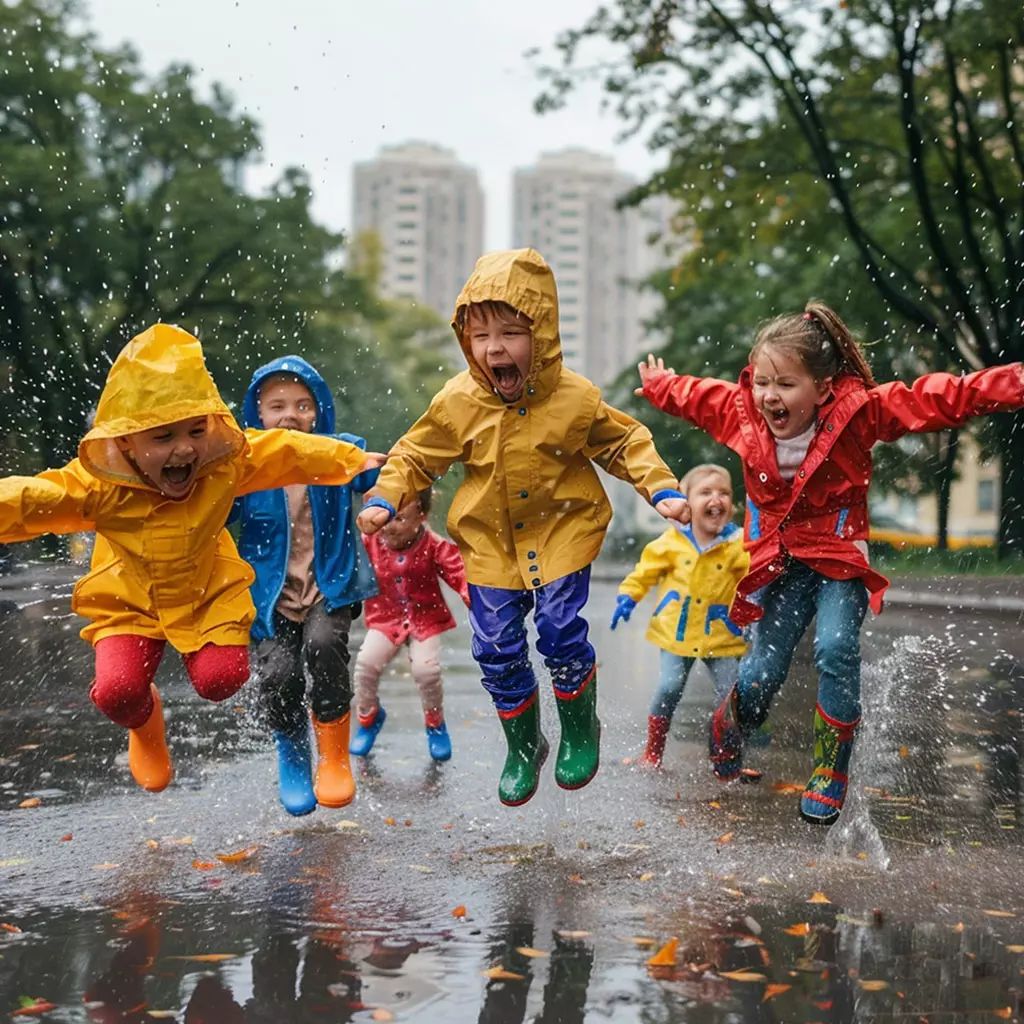
2. Turn Puddle Jumping Into a Science Experiment
Most children don’t need much encouragement to jump into a puddle.
But with a few simple questions, ordinary puddle jumping can become an exciting science experiment.
Put on rain boots and waterproof clothing and head outside to safely explore puddles around your neighborhood.
Ask your child questions such as:
- Which puddle is the deepest?
- Which puddle is the widest?
- Why do you think water collects in some places but not others?
- What happens when you drop a leaf into the water?
- Which objects float and which objects sink?
- Does jumping from higher up create a bigger splash?
Children can also measure puddles using a ruler or measuring tape and compare their sizes.
This activity introduces basic concepts related to measurement, gravity, water displacement, and scientific observation while keeping children physically active.
Families looking for educational activities beyond the backyard can also explore after-school STEM programs in Brooklyn, where children can experiment, build, create, and solve problems through hands-on science experiences.
3. Explore the Science of Snowflakes
When snow begins falling in Brooklyn, bundle up and head outside for a closer look.
Give your child a piece of black construction paper, dark fabric, or another cold, dark-colored surface.
Allow several snowflakes to land on the surface and examine them with a magnifying glass.
Encourage your child to compare different snowflakes.
Are they the same size?
Do they have similar patterns?
How quickly do they melt?
What happens when snowflakes land on a warm surface instead of a cold one?
Children can draw the snowflakes they observe or create their own snowflake designs using paper, craft sticks, or building materials.
This activity introduces children to observation, patterns, symmetry, temperature, and the fascinating science behind frozen water.
4. Measure Rainfall With a Homemade Rain Gauge
Building a simple rain gauge is an excellent way to introduce children to measurement and data collection.
Find a clear plastic container with straight sides and place it in an open outdoor area where it can safely collect rainwater.
Use a ruler and permanent marker to create measurement lines along the side of the container.
After it rains, ask your child to measure the amount of water collected.
Record the results in a notebook.
Continue collecting measurements over several rainy days and compare the results.
Which day had the most rainfall?
Which day had the least?
Did the rain fall quickly or throughout the entire day?
Children can even create a simple chart to track rainfall over time.
Activities like this help children understand that science isn’t only about conducting experiments. Scientists also observe, measure, collect information, and compare results.
5. Build a Weather Observation Station
Turn your child into a junior meteorologist by creating a simple weather observation station at home.
Choose a window, balcony, backyard, or another safe location where your child can observe the weather each day.
Create a weather journal and record information such as:
- Temperature
- Cloud conditions
- Rainfall
- Wind
- Snow
- Changes in weather throughout the day
Younger children can draw pictures of the weather, while older children can record measurements and write short observations.
Encourage your child to make predictions.
Will it rain tomorrow?
Will the temperature be warmer or colder?
Are the clouds changing?
Then check the weather the following day to see whether the prediction was correct.
This activity introduces children to data collection, patterns, forecasting, and scientific thinking.
6. Explore Sleet With a Sensory Science Activity
Sleet provides another opportunity for children to explore the science of precipitation.
If conditions are safe, collect a small amount of sleet in a clear container and bring it inside.
Allow your child to observe the sleet as it begins to melt.
Ask questions such as:
What does sleet feel like?
How is sleet different from snow?
How quickly does it melt?
What happens to the temperature of the container?
You can also create an indoor sensory bin using ice, water, measuring cups, spoons, funnels, and small containers.
Encourage children to scoop, pour, measure, and observe what happens as the frozen materials begin to melt.
This type of hands-on activity encourages sensory exploration while introducing children to temperature, states of matter, measurement, and observation.
7. Create an Indoor Engineering Challenge
Sometimes the weather makes outdoor exploration difficult.
That’s the perfect opportunity to bring STEM learning indoors.
Give your child a collection of simple building materials such as cardboard, paper cups, craft sticks, tape, blocks, or recycled containers.
Then present an engineering challenge.
Can you build a bridge that holds five toy cars?
Can you create the tallest tower possible?
Can you design a shelter that protects a toy animal from rain?
Can you build a boat that floats?
Can you create a structure that can withstand strong wind from a fan?
Encourage your child to build, test, make changes, and try again.
The goal isn’t to create a perfect structure.
The goal is to develop creativity, persistence, critical thinking, and problem-solving skills.
Children who enjoy building, experimenting, and solving challenges can continue exploring science through STEM holiday camps in Brooklyn and summer programs for kids in Brooklyn.
Why Weather Activities Are Great for Children's Development
Weather activities allow children to explore science using experiences that are already happening around them.
Instead of simply reading about rain, snow, clouds, and temperature, children can observe these natural phenomena firsthand.
Hands-on science activities can encourage children to ask questions, make predictions, experiment with ideas, and learn from the results.
These experiences can help children develop important skills, including:
- Critical thinking
- Problem-solving
- Creativity
- Observation
- Measurement
- Communication
- Fine and gross motor skills
- Curiosity about the natural world
Most importantly, children begin to understand that science isn’t something that only happens in a classroom.
Science is everywhere.
Looking for More Hands-On STEM Activities for Kids in Brooklyn?
Rainy days, snowy afternoons, weekends, and school breaks all provide opportunities for children to explore science.
But sometimes families want a place where children can conduct experiments, build inventions, tackle engineering challenges, and discover new ideas alongside other curious young scientists.
That’s where Brooklyn Science Spot comes in.
Brooklyn Science Spot provides exciting hands-on STEM experiences designed to help children learn through experimentation, creativity, and play.
Families can explore after-school STEM programs in Brooklyn, exciting summer programs for kids, hands-on holiday camps, and educational STEM school trips in Brooklyn.
You can also learn more about Brooklyn Science Spot’s mission and how hands-on science experiences help children develop curiosity, confidence, creativity, and a lifelong love of learning.
Make Every Rainy Day a Science Adventure
The next time rain clouds gather over Brooklyn, don’t automatically reach for the television remote.
Grab the rain boots, find a measuring cup, build a weather station, investigate a puddle, or create an indoor engineering challenge.
Every rainy day provides another opportunity for children to ask questions, experiment, build, create, and discover something new.
By helping children see science in the world around them, parents can transform ordinary weather into exciting learning experiences.
And when your child is ready for even more experiments, inventions, and hands-on STEM adventures, Brooklyn Science Spot is ready to keep the curiosity going.
Happy exploring!
Carmelo Piazza
Founder and Owner of Brooklyn Science Spot