Engineering Activities for Kids in Brooklyn

Engineering Activities for Kids in Brooklyn
Engineering Activities for Kids in Brooklyn
Brooklyn is filled with bridges, buildings, transportation systems, construction projects, parks, machines, and technology that can inspire children to wonder how things are designed and built.
For parents searching for engineering activities for kids in Brooklyn, the goal is often to find educational experiences that encourage children to think creatively, solve problems, and learn through hands-on exploration.
Engineering gives children opportunities to do exactly that.
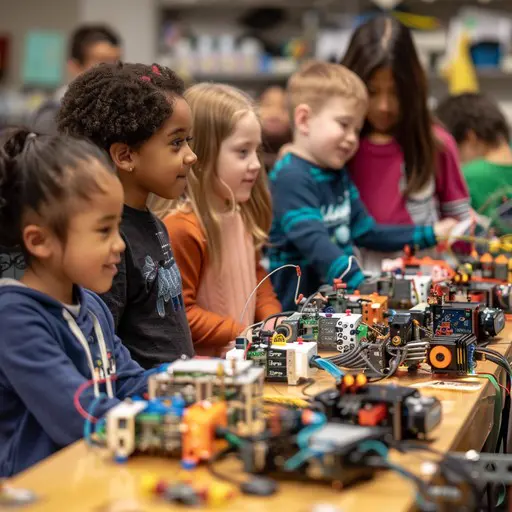
Kids can design structures, build machines, test materials, create inventions, solve challenges, and improve their ideas through experimentation.
At Brooklyn Science Spot, children explore engineering and other STEM concepts through hands-on activities designed to make learning exciting, creative, and fun.
Whether your family lives in Cobble Hill, Carroll Gardens, Park Slope, Boerum Hill, Brooklyn Heights, or another nearby Brooklyn neighborhood, engineering activities can provide children with meaningful opportunities to build, create, experiment, and discover how the world around them works.
What Is Engineering for Kids?
Engineering might sound like a complicated subject for children.
However, kids use engineering skills more often than parents may realize.
Whenever a child builds a tower, creates a structure, designs a vehicle, solves a problem, or figures out how to make something work better, they are beginning to think like an engineer.
Engineering is about identifying problems and developing solutions.
Children might ask:
How can I build a taller tower?
How can I make this bridge stronger?
How can I protect an egg from breaking?
How can I make this vehicle travel farther?
How can I move an object without touching it?
These questions encourage children to think critically, experiment with ideas, and learn from their results.
Engineering activities turn curiosity into opportunities for discovery.
Why Are Engineering Activities Important for Children?
Children are naturally creative problem-solvers.
Give a child a collection of materials and a challenge, and they will often begin experimenting immediately.
They build.
They test.
They make mistakes.
They change their designs.
Then they try again.
This process introduces children to the basic principles of engineering.
Engineering education can encourage children to combine science, mathematics, creativity, and critical thinking to solve problems.
Perhaps most importantly, engineering activities help children understand that the first solution to a problem does not always have to be the final solution.
Ideas can be tested and improved.
Engineering Teaches Children How to Solve Problems
One of the most valuable benefits of engineering activities is the opportunity to develop problem-solving skills.
Imagine giving children a collection of craft sticks, cardboard, tape, string, and other materials.
Their challenge is to build a bridge that can support as much weight as possible.
Immediately, questions begin to emerge.
What shape should the bridge be?
Which materials should we use?
How should the pieces be connected?
Why did the first bridge collapse?
What can we change to make the next design stronger?
Children must evaluate the challenge, develop ideas, build a solution, test their design, and make improvements.
Instead of simply being given the correct answer, they discover solutions through experimentation.
What Is the Engineering Design Process?
Many engineering activities follow a simple problem-solving framework called the engineering design process.
While the exact steps may vary depending on the project, children typically move through several stages.
Ask
What problem are we trying to solve?
Children begin by understanding the challenge and asking questions.
Imagine
What are some possible solutions?
Children brainstorm ideas and consider different ways to approach the problem.
Plan
Which idea should we try?
Children choose a solution, gather materials, create drawings, or discuss how they will build their design.
Create
Now it is time to build.
Children turn their ideas into physical models, structures, machines, or prototypes.
Test
Does the design work?
Children test their creations and observe what happens.
Improve
How could we make it better?
Children analyze the results, identify problems, make changes, and test again.
This process helps children understand an important lesson.
Failure is not the end of an engineering project.
It is information that can help improve the next design.
Fun Engineering Activities for Kids
Engineering activities can introduce children to STEM concepts while encouraging creativity and experimentation.
Here are several types of engineering challenges children may enjoy.
Build a Bridge
Bridge-building challenges introduce children to structural engineering.
Children can use craft sticks, cardboard, paper, straws, building blocks, or other materials to create bridges.
Once the bridge is complete, children can test how much weight it can support.
They can then redesign the bridge and try to improve its strength.
This activity introduces concepts including forces, balance, materials, structure, and weight distribution.
Design the Tallest Tower
Give children a collection of building materials and challenge them to construct the tallest freestanding tower possible.
Materials might include cups, blocks, paper, cardboard, straws, or craft sticks.
Children quickly discover that building higher structures requires careful planning.
A tall tower also needs a stable foundation.
When the tower falls, children can examine what happened and improve the next design.
Create a Marble Run
Marble runs combine engineering, physics, creativity, and experimentation.
Children can build tracks using cardboard tubes, ramps, paper, blocks, or other materials.
The goal is to guide a marble from the beginning of the course to the end.
Children can experiment with slopes, curves, obstacles, and speed.
Each change affects how the marble moves through the system.
Build a Balloon-Powered Vehicle
Balloon-powered vehicles introduce children to forces and motion.
Children design a vehicle using lightweight materials, wheels, axles, and a balloon.
When the air escapes from the balloon, it creates a force that moves the vehicle forward.
Children can experiment with wheel size, vehicle weight, alignment, and balloon placement to see which designs travel the farthest.
Design an Egg Drop Container
The egg drop challenge is a classic engineering activity.
Children must design a protective container that prevents an egg from breaking when dropped from a predetermined height.
The challenge encourages children to investigate materials, impact forces, cushioning, and structural design.
After testing their creations, children can analyze what worked, what failed, and how their designs could be improved.
Build a Paper Airplane
Paper airplanes may seem simple, but they provide excellent opportunities to explore engineering and physics.
Children can experiment with wing shapes, folds, weight distribution, and different paper types.
After each flight, they can measure distance, observe flight patterns, and modify their designs.
The activity demonstrates how small changes can affect performance.
Create a Chain Reaction Machine
Chain reaction machines require children to design a sequence of connected events.
A rolling ball might knock over blocks.
The blocks might release a toy car.
The toy car might hit another object.
Each part of the system must work correctly for the entire machine to succeed.
These activities encourage planning, experimentation, patience, and creative problem-solving.
Engineering Activities Help Children Develop Important Skills
Engineering is about more than building structures and machines.
Hands-on engineering activities can help children develop skills that support learning in school and everyday life.
Critical Thinking
Children must analyze problems, compare possible solutions, and determine why designs succeed or fail.
Creativity
There is rarely only one solution to an engineering challenge.
Children are encouraged to imagine different possibilities and develop original ideas.
Persistence
Engineering projects do not always work on the first attempt.
Children learn to adjust their designs and continue experimenting.
Collaboration
Many engineering challenges involve working with other children.
Kids learn how to share ideas, listen to different perspectives, divide responsibilities, and work toward a common goal.
Communication
Children may need to explain their designs, describe problems, present solutions, and discuss the results of experiments.
These experiences help children become more confident communicating their ideas.
Engineering Helps Children Understand the World Around Them
Brooklyn provides countless opportunities for children to observe engineering in everyday life.
Consider the Brooklyn Bridge.
Children can think about how engineers designed a structure capable of supporting enormous amounts of weight while spanning the East River.
Look at the subway system.
Engineers must consider tunnels, tracks, electricity, ventilation, transportation, safety, and thousands of other challenges.
Buildings, playgrounds, bicycles, elevators, traffic lights, water systems, computers, and household appliances are all examples of engineering.
Encouraging children to observe these systems can help them understand that engineering is not simply a school subject.
Engineering shapes the world around them.
Hands-On Engineering vs. Learning From a Textbook
Books and classroom instruction can introduce children to important engineering concepts.
However, engineering is fundamentally about applying ideas to solve problems.
Hands-on activities give children opportunities to experience the process themselves.
Instead of simply reading about structural engineering, children can build a bridge.
Instead of memorizing facts about forces, children can design and test a vehicle.
Instead of learning about machines only through diagrams, children can build their own.
These experiences can help children understand abstract concepts by making them visible and tangible.
Parents looking for ongoing opportunities for their children to experiment, build, and solve problems can explore our After-School Programs.
Engineering Activities Near Cobble Hill and Carroll Gardens
For families living in Cobble Hill and Carroll Gardens, finding convenient educational activities can make it easier to incorporate enrichment programs into a child’s weekly routine.
Parents often want programs that are close to home while providing meaningful learning experiences beyond the traditional classroom.
Brooklyn Science Spot offers hands-on STEM experiences that encourage children to experiment, build, create, and solve problems.
Engineering activities can give children opportunities to explore their ideas while developing confidence in their ability to overcome challenges.
Families interested in ongoing STEM enrichment can explore our After-School Programs or learn more about Brooklyn Science Spot.
Engineering Activities Can Make School Subjects More Meaningful
Children sometimes ask why they need to learn certain subjects in school.
Engineering helps provide an answer.
Mathematics can be used to measure structures, calculate distances, compare results, and analyze designs.
Science helps children understand forces, materials, energy, electricity, motion, and other concepts.
Reading helps children research problems and understand instructions.
Writing helps children record observations and communicate ideas.
Art and creativity help children imagine solutions and design prototypes.
Engineering brings these subjects together.
Instead of learning concepts separately, children discover how knowledge can be applied to solve real problems.
Engineering Activities During School Breaks and Summer
Children can continue exploring engineering throughout the year.
School breaks and summer provide opportunities for longer projects, creative challenges, and extended STEM experiences.
Families looking for educational activities when school is closed can explore our Holiday Camps.
During the summer, children can continue building, experimenting, and discovering through our Summer Programs.
Brooklyn Science Spot also offers educational experiences for schools and organizations through our STEM School Trips.
Engineering Activities Parents Can Try at Home
Parents do not need expensive equipment to encourage engineering thinking.
Many engineering challenges can be created using common household materials.
Cardboard boxes can become buildings.
Paper can become bridges.
Plastic cups can become towers.
Straws can become structures.
Toy cars can be used to investigate ramps and motion.
The goal is not necessarily to create a perfect final product.
The goal is to encourage children to ask questions.
Why did that happen?
How could we make it stronger?
What happens if we change the design?
Can we find another solution?
Parents looking for additional ideas can explore engineering projects and educational resources through DiscoverE Engineering Activities.
How Parents Can Encourage Engineering Thinking
Parents can help children develop engineering skills by changing the types of questions they ask.
Instead of immediately showing a child how to solve a problem, ask questions that encourage investigation.
What do you think will happen?
Why do you think the structure fell?
What could you change?
Is there another way to solve the problem?
What materials might work better?
How could you test your idea?
These questions encourage children to think independently and develop confidence in their ability to solve problems.
Finding Engineering Activities for Kids in Brooklyn
The best engineering activities do more than keep children busy.
They challenge children to think.
They encourage creativity.
They provide opportunities to experiment.
They teach children how to solve problems.
They show children that failure can be an important part of learning.
Most importantly, engineering activities help children develop confidence in their ability to create solutions and understand the world around them.
For families searching for engineering activities for kids in Brooklyn, hands-on STEM programs can provide meaningful educational experiences that combine learning, creativity, experimentation, and fun.
Located near Cobble Hill and Carroll Gardens, Brooklyn Science Spot provides opportunities for children to explore engineering, science, technology, and other STEM concepts through hands-on learning experiences.
Explore our After-School Programs, discover our Summer Programs, or learn more about Brooklyn Science Spot to find STEM learning opportunities for your child.
Frequently Asked Questions About Indoor Activities for Kids in Brooklyn
What are engineering activities for kids?
Engineering activities are hands-on challenges that encourage children to identify problems, design solutions, build prototypes, test their ideas, and make improvements
What age can children start learning engineering?
Children can begin exploring basic engineering concepts at a young age through building, experimenting, designing, and problem-solving activities appropriate for their developmental level.
Are engineering activities good for elementary school students?
Yes. Engineering activities can help elementary school students develop problem-solving, critical thinking, creativity, communication, and collaboration skills while applying science and mathematics concepts.
What types of engineering projects can kids do?
Children can build bridges, towers, vehicles, marble runs, simple machines, protective containers, paper airplanes, chain reaction machines, and many other structures and devices.
Are there engineering activities for kids near Cobble Hill and Carroll Gardens?
Brooklyn Science Spot provides hands-on STEM learning experiences for families in Cobble Hill, Carroll Gardens, and surrounding Brooklyn neighborhoods.
Do children need engineering experience to participate?
No. Children can participate in age-appropriate engineering activities regardless of their previous experience. Hands-on programs can introduce children to engineering concepts through experimentation, building, and creative problem-solving.