What Do Kids Actually Do in a STEM After-School Program?

What Do Kids Actually Do in a STEM After-School Program?
When parents search for an after-school program, they often see the same words: enrichment, STEM, hands-on learning, creativity, and problem-solving.
But what does that actually mean?
What do children really do when they walk into a STEM after-school program?
The answer is much more exciting than sitting at a desk completing worksheets or listening to another classroom lesson.
At Brooklyn Science Spot, children learn by building, experimenting, creating, testing ideas, solving problems, and discovering how science works through hands-on experiences.
For families searching for STEM after-school programs in Brooklyn, especially those living in Cobble Hill, Carroll Gardens, Boerum Hill, Brooklyn Heights, Park Slope, and nearby neighborhoods, understanding what happens during a typical STEM program can help parents choose an after-school experience that keeps children engaged while encouraging curiosity and learning.
What Is a STEM After-School Program?
A STEM after-school program gives children opportunities to explore science, technology, engineering, and mathematics outside the traditional classroom environment.
Instead of simply reading about scientific concepts, children get opportunities to experience them.
They might build a bridge.
Launch a rocket.
Create a chemical reaction.
Design a structure.
Experiment with magnets.
Explore electricity.
Build a machine.
Test different materials.
Or solve an engineering challenge.
These activities turn scientific concepts into experiences children can see, touch, test, and understand.
At Brooklyn Science Spot, our programs are designed to make science exciting, approachable, and fun while encouraging children to ask questions, experiment with ideas, and discover how the world around them works.
Parents who want to learn more about the educational approach behind these activities can also explore our guide to hands-on STEM learning.
Kids Conduct Hands-On Science Experiments
One of the biggest differences between a STEM after-school program and traditional childcare is the opportunity for children to actively participate in science experiments.
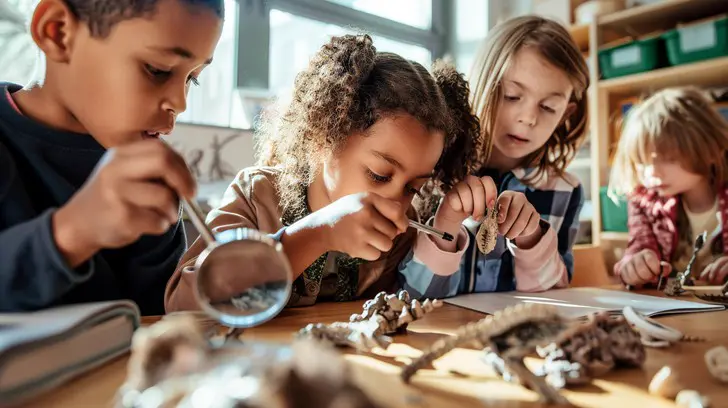
Children might explore chemistry by creating colorful reactions, investigate physics by experimenting with motion and forces, or learn about biology by examining plants, insects, and ecosystems.
The goal is not simply to demonstrate an experiment.
Children participate in the process.
They make predictions.
They observe what happens.
They ask questions.
They compare results.
They try again.
This type of hands-on exploration encourages children to think like young scientists.
Organizations such as the Smithsonian Science Education Center promote inquiry-based science education that encourages students to investigate questions, gather evidence, and develop explanations through active learning.
Kids Build, Design, and Engineer Things
Engineering is one of the most popular parts of many STEM after-school programs because children get to create something with their own hands.
A child might be challenged to build the tallest tower using limited materials.
Another activity might involve designing a bridge capable of supporting weight.
Children may build vehicles, create structures, design machines, or experiment with different materials.
But the first design does not always work.
And that is part of the experience.
Children learn to test their ideas, identify problems, make improvements, and try again.
This process introduces children to the engineering design process while teaching persistence, creativity, and problem-solving.
The National Science Teaching Association provides educational resources that support hands-on science learning and inquiry-based STEM instruction.
Kids Solve Problems Through Trial and Error
In many school subjects, children are taught to search for the correct answer.
STEM activities often work differently.
There may be several ways to solve the same challenge.
Children might need to figure out how to keep a structure standing, make an object travel farther, protect an egg from breaking, or design something using only a limited number of materials.
Their first idea might not work.
Neither might their second.
But each attempt gives them new information.
Children learn to observe what happened, change their approach, and test another idea.
This process helps children become more comfortable with challenges and teaches them that mistakes can be part of learning.
Kids Ask Questions and Explore Their Curiosity
Children naturally ask questions.
Why does that happen?
How does this work?
What happens if I change this?
Can I make it bigger?
Can I make it faster?
Can I build it differently?
A strong STEM after-school program encourages those questions.
Instead of immediately giving children the answer, instructors can help them investigate possibilities, make predictions, conduct experiments, and discover answers through exploration.
This type of inquiry-based learning can help children develop stronger observation, reasoning, and critical-thinking skills.
NASA offers a wide variety of STEM activities and learning resources for students that encourage children to explore science, engineering, space, and technology through hands-on learning.
Kids Work Together on STEM Challenges
STEM activities are not always individual projects.
Many challenges encourage children to work together.
A group might need to build a structure, solve an engineering problem, complete an experiment, or develop a creative solution.
Children learn how to share ideas, listen to others, divide responsibilities, communicate their thinking, and work toward a common goal.
These experiences can help children develop communication and teamwork skills while participating in educational activities.
Kids Develop Creativity Through Science and Engineering
Science and creativity are often treated as completely different subjects.
In reality, they work together.
Many STEM activities require children to imagine possibilities before they can build or test anything.
A child designing a machine must decide how it should work.
A child building a structure must think about its shape and materials.
A child solving an engineering challenge may need to develop several different solutions.
STEM activities give children opportunities to combine imagination with scientific thinking.
That combination can make learning more engaging while helping children understand that science is not simply about memorizing facts.
It is also about discovering possibilities.
Kids Learn About Science in the World Around Them
STEM learning does not stop when children leave the classroom.
Science, technology, engineering, and mathematics are everywhere.
Buildings involve engineering.
Cooking involves chemistry.
Weather involves earth science.
Bridges involve physics.
Plants and animals involve biology.
Technology shapes how people communicate, travel, work, and solve problems.
A strong STEM after-school program can help children begin recognizing these connections.
Families can continue encouraging this curiosity by exploring educational activities for kids in Brooklyn and looking for opportunities to ask questions about the science and engineering they encounter every day.
Kids Gain Confidence by Creating Something Themselves
There is something powerful about watching an idea become real.
A child designs a structure.
Builds it.
Tests it.
Discovers a problem.
Changes the design.
And eventually gets it to work.
That process can create a genuine sense of accomplishment.
Instead of simply being told that they understand a concept, children can see the results of their own thinking and effort.
Over time, these experiences can help children become more willing to attempt new challenges, explore unfamiliar ideas, and participate in problem-solving activities.
Is a STEM After-School Program Right for Your Child?
STEM programs can be a great fit for children who enjoy asking questions, building things, conducting experiments, solving puzzles, creating projects, or discovering how things work.
But children do not need to already love science to participate.
One of the benefits of hands-on STEM activities is that they introduce scientific concepts through experiences that feel active, creative, and fun.
Children can discover new interests while participating in experiments, engineering challenges, collaborative activities, and science-based projects.
Parents comparing different options may also want to read our guide on how to choose the right after-school program for your child.
STEM After-School Programs for Kids in Brooklyn
Families living in Cobble Hill, Carroll Gardens, Boerum Hill, Brooklyn Heights, Park Slope, and surrounding Brooklyn neighborhoods have many options when choosing after-school activities.
At Brooklyn Science Spot, our goal is to create an environment where children can explore science through hands-on activities, experiments, engineering challenges, creative problem-solving, and discovery.
Children are encouraged to ask questions, test ideas, build things, make mistakes, try again, and experience the excitement of figuring something out for themselves.
Families interested in continuing the STEM experience beyond the school year can also explore our summer STEM programs and school break camps.
More Than Just Something to Do After School
Parents are not simply looking for somewhere their children can spend a few hours after the school day ends.
They want their children to be safe, engaged, active, and excited about what they are doing.
A STEM after-school program can provide children with opportunities to experiment, build, create, collaborate, solve problems, and discover new interests.
The best programs create experiences children look forward to attending.
At Brooklyn Science Spot, science powers the fun.
Children explore the world through hands-on experiments, engineering challenges, creative activities, and exciting STEM experiences designed to encourage curiosity and discovery.
If you are looking for a STEM after-school program in Brooklyn near Cobble Hill, Carroll Gardens, Boerum Hill, Brooklyn Heights, or Park Slope, explore our STEM after-school programs and discover how your child can learn, build, experiment, and create.
Frequently Asked Questions About STEM After-School Programs
What age is best for a STEM after-school program?
Children can begin participating in age-appropriate STEM activities at a young age. The best programs adapt experiments, engineering challenges, and learning activities to match children’s developmental abilities and interests.
Do children need to be good at science to join a STEM program?
No. STEM after-school programs are designed to help children explore science through hands-on activities and discovery. Children do not need prior science experience to participate.
What skills do children develop in STEM after-school programs?
Children may develop problem-solving, critical-thinking, creativity, communication, teamwork, observation, and persistence skills while participating in hands-on STEM activities.
Are STEM after-school programs educational or just for fun?
Strong STEM programs combine education and fun. Children learn scientific and engineering concepts while participating in experiments, challenges, projects, and creative activities.
Where can I find a STEM after-school program in Brooklyn?
Brooklyn Science Spot provides hands-on STEM experiences for children and families in Cobble Hill, Carroll Gardens, Boerum Hill, Brooklyn Heights, Park Slope, and surrounding Brooklyn neighborhoods.